Corporate Mergers and Criminal Responsibility : A Comparative Legal Study

Lamiae ABOUZID
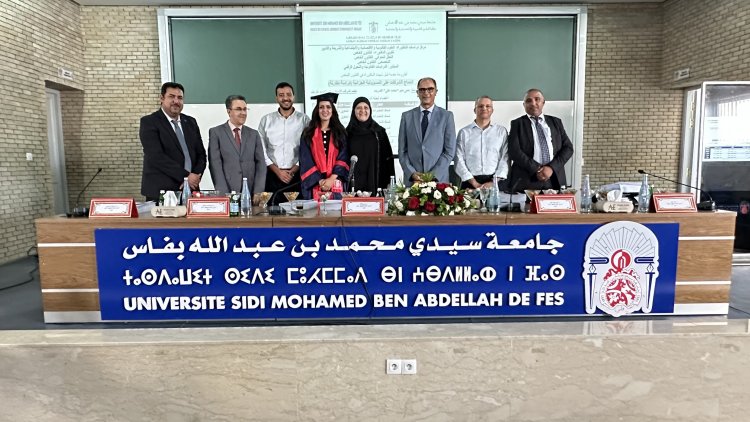
In today’s global economic climate, marked by a surge in corporate mergers and restructurings, the question of how criminal liability is transferred between companies has emerged as a critical legal issue. On Saturday, July 19, 2025, Jordanian doctoral candidate Mona Mounir Mohammed Ali ACHARIDAH successfully defended her PhD thesis at Sidi Mohamed Ben Abdellah University in Fez. Her research, blending scientific rigor with comparative insight, delves into this complex and often overlooked topic.
Entitled “The Effect of Corporate Mergers on Criminal Liability: A Comparative Study”, the thesis was defended as part of a doctoral program in private law, under the supervision of Professor Abdelhamid AKHRIF. The public defense took place in an atmosphere of high academic distinction, drawing prominent figures from the legal field.
The examination committee was chaired by Professor Mohammed BOUZLAFA, Dean of the Faculty of Law, who also served as a reviewer. The panel included Professors Ahmed Anouar NAJI, Abdelkader KARMOUCH, and Amine AAZZANE, alongside the supervisor, Professor AKHRIF. Their interventions enriched the discussion with precision and depth, and the panel unanimously commended the quality of the research and the relevance of the topic.
The thesis stands out for its methodological excellence and clear, refined language. It ventures into a relatively unexplored area in Arab legal systems: the intersection of corporate law and criminal law in the context of mergers and restructurings.
Starting from the observation that many Arab legal frameworks lack clear provisions regarding the transmission of criminal responsibility during mergers, Acharidah undertakes a detailed comparative analysis. She contrasts legal mechanisms in Jordan, Egypt, Morocco, France, and Anglo-American jurisdictions.
Her study offers a cross-cutting perspective—at the crossroads of criminal and corporate law. It highlights the dilemmas posed by mergers in terms of sustaining criminal prosecutions, avoiding opportunistic mergers used to escape penalties, and balancing the principle of personal culpability with the demands of effective deterrence and enforcement in economic crime.
The thesis’s scholarly value lies in two main contributions. First, in its original focus—an area typically examined through commercial or tax-related lenses rather than criminal liability. Second, in the author’s nuanced analytical framework, supported by real-world case studies and comparative legal analysis, which helps fill a clear gap in contemporary Arab legal scholarship.
Beyond descriptive analysis, Acharidah puts forward actionable recommendations for reform. She calls for the adoption of legal mechanisms that ensure continuity in criminal responsibility when companies undergo transformation or mergers, while safeguarding fundamental rights such as due process and fair trial standards.
At the conclusion of the defense, the jury unanimously awarded the thesis the highest distinction: Très Honorable with a recommendation for publication. The committee praised the candidate’s intellectual maturity, analytical precision, and alignment with the highest international standards in doctoral research.
More than an academic achievement, this defense contributes meaningfully to ongoing legal discourse. It advances reflection on the modernization of corporate criminal law across the Arab-Mediterranean region. By bridging legal systems and challenging the foundations of criminal liability in a shifting economic landscape, Mona Mounir Acharidah’s work signals a forward-looking vision—one where law is not only a guardian of justice but a guide for evolving corporate realities.